The Consort
Penelope Cave
Summer 2025
Charles Noblet
Three Suites for harpsichord
ed MICHAEL TALBOT
Edition HH 613, 2024
ISMN 979 0 708213 27 7
www.editionhh.co.uk
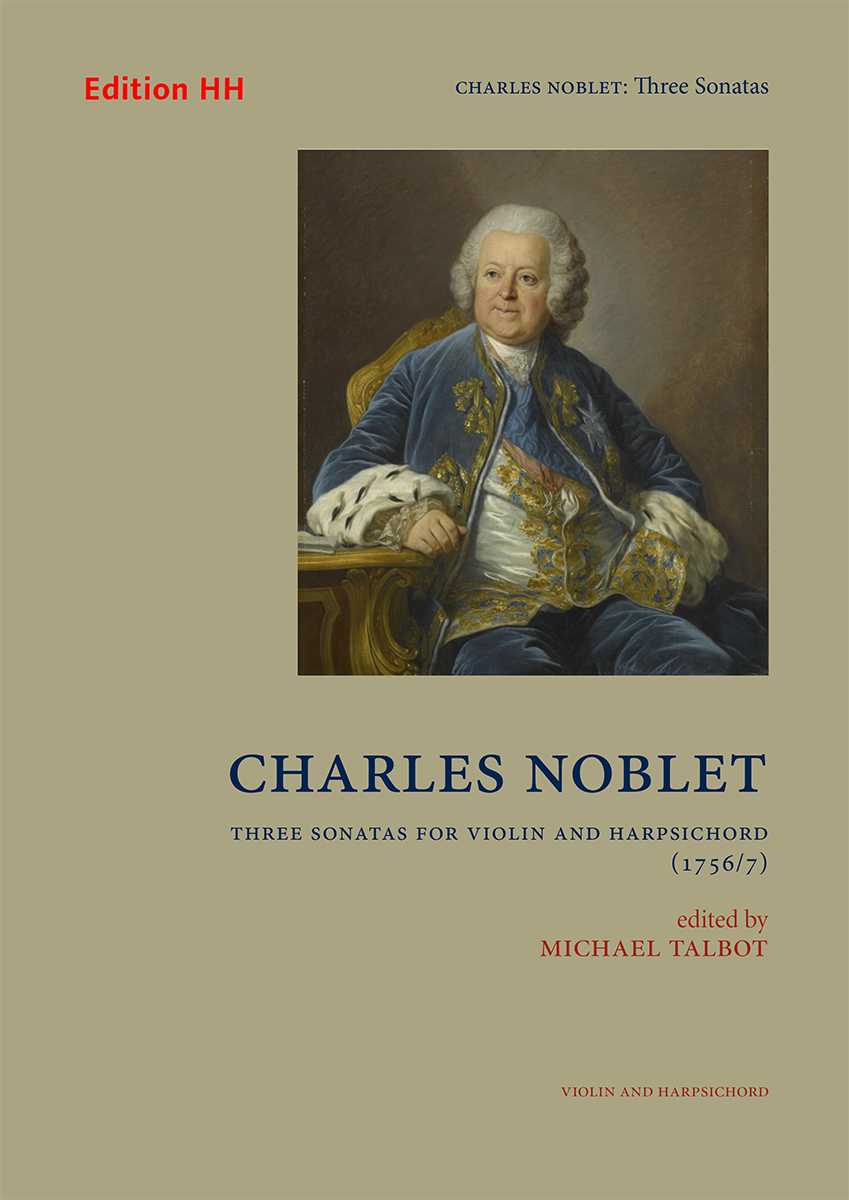
Charles Noblet
Three Sonatas for violin and harpsichord
ed MICHAEL TALBOT
Edition HH 614, 2024
ISMN 979 0 708213 28 4
www.editionhh.co.uk
The two volumes (as presented by HH), were advertised for sale in January 1757, and originally published together, so each suite was followed by a sonata. It would have been a useful volume to cover both solo and duo performance, and therefore one to be kept on the music-stand, for sociable entertainment. Charles Noblet, (1715-69), teacher, composer, and organist of several churches and convents in Paris, finished his career as harpsichordist of the Paris Opera, but has been neglected, since. These two volumes are presented in clear, modern notation utilising treble and bass clefs.
The three solo harpsichord suites of pieces start with a homage to the imaginative, and skilful late baroque French composers with rich harmonic and textural figuration, generously embellished. This opening hybrid movement is an untitled C minor allemande which surely shares its ancestry with a grand overture, and merely marked noblement — perhaps deliberately uniting the noble dedicatee with the composer’s own name. The first five-movement suite, with some characteristic French titles and three examples of the favoured French rondeau, does not go much beyond the world of François Couperin. Noblet’s second suite in G major/minor opens with repeated chords in alternate hands, an arrogant piece that seems to be a homage to Rameau and his three types of batteries which he showcased in les Cyclopes (and noted in his Pièces de Clavecin of 1724/31). As well as Rameau’s effect of ‘two drumsticks’, Noblet, continues with the left-hand figuration where the thumb always plays the middle note which Rameau exemplified in his ornament table as the first of his batteries, and then Noblet also employs the crossed hands that may have been first introduced in Paris by Scarlatti. Noblet’s contrasting dynamic markings, cross-beat slurs, and his use of some dissonance feels later in style in the six movements of his second suite, and although the fine Sarabande is securely baroque, a piece entitled La Hongroise, to be played fast, includes unison passages, Lombardic dotted rhythms, flashy arpeggiation, and strummed chords which he also uses in Les Catalans, the final piece of the third suite, in G minor/major. As this last work has just three The Consort movements, one might make one’s own choice from the combined nine movements of these latter two suites.
The sonatas show more Italianate traits, each with three movements and mostly headed with Italian speed indications, although a Tendrement, Tambourin, and Menuet do slip through the net. Italianate, violin-like figuration is present in both instrumental parts, with accompaniment patterns found in later French composers such as Duphly and Balbastre. Unlike many sonatas of this genre, where the solo instrument merely accompanies the keyboard, the violin and harpsichord sonatas are true duos, and there is a separate violin score provided. HH has provided a good modern edition of music by a composer undeservedly overlooked.
We are grateful to the The Consort for permission to reproduce this review.


 Three Suites
 Playing score
 Three Sonatas